The Complete Guide for Retailers and Distributors
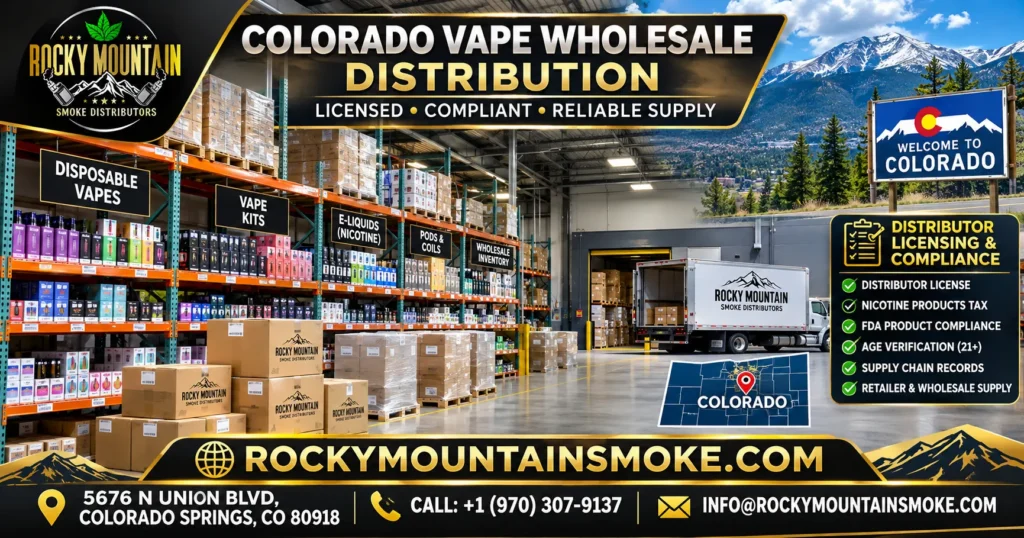
Vape wholesale requirements in Colorado cover a layered set of state licenses, excise tax rules, age limits, and federal product regulations that every buyer and seller must understand before the first purchase order is placed. Whether you are opening a new smoke shop, adding disposable vapes to a convenience store, or supplying other businesses as a distributor, Colorado expects you to hold the correct licenses, collect and remit nicotine products tax, verify the age of every customer, and sell only products that comply with federal law.
This guide from Rocky Mountain Smoke, a Colorado vape and tobacco retailer and wholesaler based in Colorado Springs, explains each requirement in plain language. You will learn which agencies regulate the industry, which licenses apply to your role, how the nicotine products tax works, what the FDA expects from the products on your shelves, how to keep clean records, and how to choose a trustworthy wholesale partner. Use it as a practical checklist, and always confirm current details with the Colorado Department of Revenue before you act. Vape Wholesale Requirements Colorado
Why Vape Wholesale Requirements in Colorado Matter
Colorado is one of the more heavily regulated states for nicotine products. Voters approved Proposition EE in 2020, which created a state tax on nicotine products, and the state has required retailers to hold a license since July 1, 2021. Together with federal oversight from the FDA, these rules mean that a wholesale vape business cannot treat compliance as an afterthought.
Understanding vape wholesale requirements in Colorado protects your business in four important ways:
- Legal protection: Selling nicotine products without the proper license is unlawful, and willful violations can lead to criminal penalties.
- Financial protection: Unpaid excise tax, penalties, and seized inventory can quickly erase your profit margin.
- Reputation protection: Customers and partner businesses prefer suppliers who are transparent, licensed, and consistent.
- Long-term growth: A compliant business can renew its licenses, pass audits, and expand into new locations without disruption.
At Rocky Mountain Smoke, the owner built the business on a simple belief: he wants every retailer who buys from him to feel confident that the products, paperwork, and pricing are handled correctly. This guide shares that same approach.
Who Needs a License in the Colorado Vape Supply Chain?
Not every business in the vape supply chain needs the same license. The requirements depend on where you sit in the chain and what you actually do with the product. The main roles are described below.
Nicotine Products Distributors
The Colorado Department of Revenue requires a distributor license for anyone who first receives nicotine products in Colorado, who sells nicotine products in Colorado and is primarily liable for the nicotine products tax, or who first sells nicotine products imported from another state or country. In practical terms, a business that buys vapes from a manufacturer or an out-of-state seller and then sells them to Colorado retailers is a distributor and needs this license. A separate license is required for each place of business.
Wholesalers and Subcontractors
If your business also handles cigarettes, a separate cigarette wholesaler license applies. The state also recognises wholesale subcontractors and distributing subcontractors, who act on behalf of a licensed company. Cigarette wholesalers must meet additional conditions, including Master Settlement Agreement reporting and, in many cases, a bond tied to stamp purchases.
Retailers
Retailers who buy from a wholesaler need their own state retail license. A retailer that offers cigarettes, tobacco products, or nicotine products must be licensed by the Liquor and Tobacco Enforcement Division. If you are a retailer reading this guide, your first compliance question is whether your supplier is properly licensed, because that affects your own risk.
Remote and Online Sellers
Businesses that ship nicotine products to Colorado customers face extra layers of rules, including federal delivery sale requirements and age verification. Online sellers should review both state guidance and the federal PACT Act before shipping anywhere.
Colorado Nicotine Products Distributor License: Step by Step
The nicotine products distributor license is the core of vape wholesale requirements in Colorado. It is issued by the Colorado Department of Revenue, Taxation Division, and it is managed through the state’s Revenue Online system. The process below gives you a clear path to follow.
- Confirm your business structure. Decide whether you will operate as an individual, partnership, corporation, or limited liability company, and register the entity with the Colorado Secretary of State if required.
- Obtain a Colorado sales tax license. An applicant must hold a current Colorado sales tax license, and the license cannot be renewed if delinquent Colorado taxes are owed unless a payment agreement exists.
- Create a Revenue Online account. Most Department of Revenue applications, filings, and payments are completed online.
- Complete the nicotine products distributor application. The Department provides a form for this purpose, and you will describe how you receive and sell nicotine products, such as purchasing from manufacturers or unlicensed out-of-state sellers, or shipping to Colorado retailers.
- Submit the application and pay any applicable fee. Check the current fee schedule on the Department’s website before you apply.
- Display and maintain the license. Keep your license current, report changes in ownership or location, and renew on time.
The state publishes a list of licensed distributors, and smart retailers check that list before they sign a supply agreement. If a seller cannot show a valid license, that is a warning sign.
License Revocation and Penalties
If a licensee violates any provision of law that applies to the nicotine products tax, the Department can act against the license. It is unlawful for any distributor to sell or distribute nicotine products in Colorado without a license, and willful violations carry criminal penalties. For this reason, you should never begin wholesale sales while your application is still pending.
Colorado Sales Tax License and Resale Certificates
A Colorado sales tax license is a prerequisite for the distributor license, and it also matters in daily wholesale transactions. When a retailer buys vape products for resale, the sale is generally a wholesale transaction, and the buyer provides a resale certificate rather than paying sales tax at the wholesale level. The retailer then collects sales tax from the final customer.
To manage this correctly, keep the following on file for every wholesale account:
- A copy of the buyer’s Colorado sales tax license or account number
- A signed resale certificate or exemption documentation
- The buyer’s state retail license information
- The delivery address and the business name that appears on the license
Accurate files make audits simple. If the Department of Revenue ever questions a sale, your documents will show that the transaction was a valid sale for resale.
Nicotine Products Excise Tax in Colorado
The nicotine products tax is the financial heart of vape wholesale requirements in Colorado. Proposition EE created this tax, and it applies to e-cigarettes, vapes, nicotine pouches, and other products that contain nicotine but do not contain tobacco.
How the Tax Is Calculated
The tax is a percentage of the manufacturer’s list price, which is the price at which the manufacturer sells the product to a distributor. It is not based on the retail shelf price, and it is not based on a discounted promotional price. Under Colorado law, the rate for most nicotine products is 56 per cent of the manufacturer’s list price for the period that began on July 1, 2024, and it is scheduled to rise to 62 per cent on July 1, 2027. A lower rate applies to products that the FDA has authorised as modified risk tobacco products.
Who Pays the Tax
The tax is imposed at the time the distributor first receives nicotine products in the state, sells them in the state, or sells products imported from elsewhere. In other words, the licensed distributor is primarily liable. Wholesalers usually build the tax into their wholesale price, so retailers should ask suppliers to show how the tax is handled on every invoice.
Why Manufacturer’s List Price Matters
The Department of Revenue has also been clarifying how the manufacturer’s list price is defined for nicotine products. A distributor should not assume that a discounted invoice reduces the taxable value. Keep the manufacturer’s price documentation for each product, and speak with a qualified tax professional if you are unsure.
Filing and Payment
Licensed distributors file returns and pay the tax through the state’s online system. Many businesses also enrol in electronic funds transfer for tax payments. Late filings can lead to penalties and interest, so set calendar reminders and reconcile your sales records every month.
Retail Licensing and What Your Wholesale Buyers Need
As a wholesale supplier, you want fully compliant customers, and as a retailer, you want to prove that you are. Since July 1, 2021, the Liquor and Tobacco Enforcement Division has required retailers to hold a state license to sell cigarettes, tobacco products, or nicotine products.
Key points for retail buyers include:
- A state retail license is required for each retail location.
- If your city or county issues its own tobacco license, a copy must accompany the state application.
- The application asks whether the location already has a license and whether the applicant has ever had a tobacco license suspended or revoked.
- Retailers who deliver products to customers may need a separate delivery permit.
- Violations can lead to suspension, revocation, or a prohibition on selling at a location.
Wholesalers should treat a buyer’s retail license as part of the customer onboarding process. It is easier to verify a license before the first order than to explain a problem after a regulator visits.
Age Requirements: Tobacco 21 in Colorado
Colorado law prohibits the sale of cigarettes, tobacco products, and nicotine products to anyone under 21 years of age, and federal law sets the same minimum age. These rules apply to every sale, including sales made by a wholesaler to a licensed business and sales made at a retail counter.
Practical steps for compliance include:
- Check a valid government-issued photo ID for every retail customer who appears under a conservative age threshold.
- Train every employee on how to spot altered or fake identification.
- Use clear signage at the point of sale that states the minimum age.
- Refuse a sale whenever you have any doubt about a customer’s age.
- Keep written records of employee training sessions.
Wholesalers should also confirm that a buyer is a legitimate business and not an individual consumer. Selling at wholesale to a person who plans to resell to minors creates serious legal risk.
Federal Vape Regulations Every Colorado Wholesaler Should Know
State licensing is only one half of vape wholesale requirements in Colorado. Federal law governs which products may legally be sold in the first place.
FDA Premarket Authorisation
Under federal law, e-cigarettes and other electronic nicotine delivery systems are tobacco products. A new tobacco product generally needs FDA authorisation before it can be legally marketed in the United States, usually through a premarket tobacco product application. The FDA maintains public lists of authorised products and has taken enforcement action against unauthorised products. Because the federal landscape changes often, wholesalers should check the FDA’s current guidance before adding any item to their catalogue.
Product Labelling and Warnings
Nicotine products must carry required health warning statements, and labels must be accurate. Wholesalers should inspect incoming shipments for damaged packaging, missing warnings, and counterfeit goods. Counterfeit disposable vapes are a growing problem, and they can contain unknown ingredients.
The PACT Act
The Prevent All Cigarette Trafficking Act sets rules for remote and delivery sales of certain tobacco products, and its reach was extended to electronic nicotine delivery systems in recent years. If you ship vape products to customers by mail or courier, you may face registration, reporting, age verification, and tax requirements at both the federal and state levels. Carriers have also limited the shipment of these products, so check the policy of any shipping company before you ship.
Manufacturer and Importer Duties
Businesses that manufacture or import e-cigarettes have additional federal obligations, such as registration and product reporting. A wholesaler who only buys and resells has fewer duties, but it still has a responsibility to avoid selling products that are known to be unauthorised.
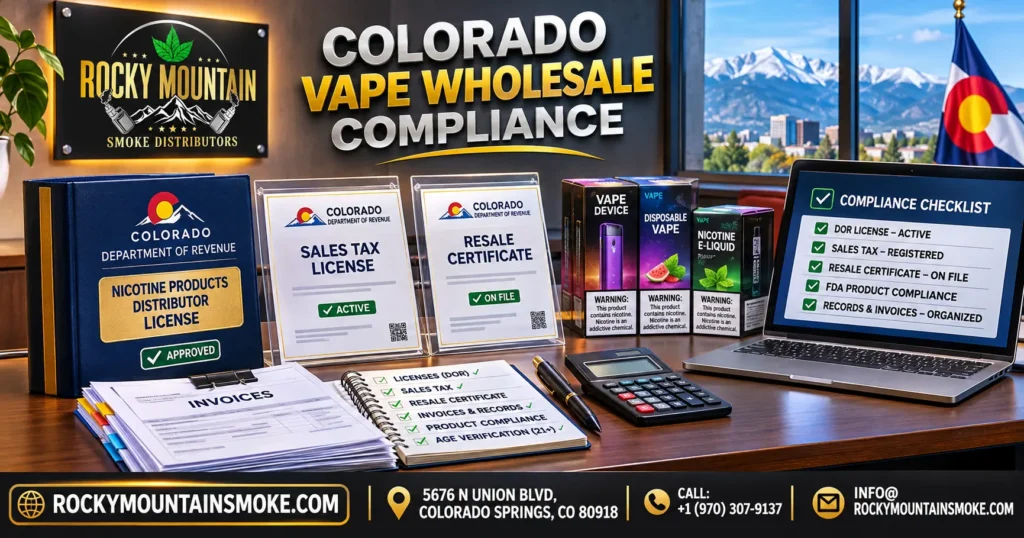
Wholesale Vape Compliance Checklist for Colorado Buyers
Use this checklist before you sign any supply agreement. It works for new retailers, convenience stores, dispensary-adjacent shops, and established smoke shop chains.
- Supplier license: Ask for the supplier’s Colorado nicotine products distributor license number and verify it on the state’s list.
- Your own licenses: Confirm that you hold the Colorado sales tax license and the state retail license for every location.
- Product authorisation: Ask the supplier which products have FDA authorisation, and keep any proof they provide.
- Tax treatment: Ask how the nicotine products tax is reflected on the invoice.
- Packaging inspection: Check for required warnings, lot numbers, and signs of tampering or counterfeiting.
- Age policy: Make sure your store has an age verification procedure and trained staff.
- Recordkeeping: Keep invoices, delivery receipts, and licenses for the period required by the state.
- Returns and defects: Review how the supplier handles damaged, expired, or recalled products.
Recordkeeping, Invoices, and Audits
A well-organised record system is one of the most valuable assets in a wholesale business. The Colorado Department of Revenue may review the books of any licensed distributor, and records show whether tax was collected and paid correctly.
Strong records include the following:
- Itemised invoices that list the product, quantity, price, buyer, and date
- Manufacturer price documentation that supports the manufacturer’s list price
- Copies of every customer’s license and resale certificate
- Tax returns, payment confirmations, and correspondence with the Department
- Inventory counts and shipping records
Store these records in both digital and secure paper form, and back them up regularly. Many wholesalers also run an internal review each quarter, comparing purchases, sales, and tax filings to catch errors early.
Local Rules in Colorado Cities and Counties
Statewide rules are not the full story. Colorado cities and counties may add their own tobacco and nicotine rules, which can include local licenses, zoning limits, restrictions on flavoured products, and distance requirements from schools. These rules differ from one community to the next, and they can change when a local government passes a new ordinance.
Before you open a store or deliver to a new town, contact the local licensing office and the planning department. Retail buyers should also check local rules before placing a large order, because a product that is lawful in one city may be restricted in another.
A Practical Launch Plan for a New Colorado Vape Wholesale Business
Many new owners ask where to begin, so here is a simple timeline that organises vape wholesale requirements in Colorado into manageable stages.
Stage One: Planning and Registration
Start by choosing your business structure, registering your business name, and opening a business bank account. Then apply for your Colorado sales tax license. Because the distributor license depends on it, this step should happen early. Create your Revenue Online account at the same time so that you can submit forms without delay.
Stage Two: Licensing and Compliance Setup
Next, complete the nicotine products distributor application and confirm whether you also need tobacco products or cigarette licenses. If you sell at retail as well, apply for the state retail license and any city or county license. Build your compliance binder during this stage, and include copies of every license, form, and confirmation number.
Stage Three: Supplier and Product Selection
Choose manufacturers and suppliers that can document their products and licenses. Review the FDA’s current guidance, and decide which product categories fit your customers. Many businesses begin with a focused catalogue and expand later, because a smaller catalogue is easier to track for tax and authorisation purposes.
Stage Four: Systems and Training
Set up accounting software that records the manufacturer’s list price, the tax due, and the buyer for every sale. Train your team on age verification, recordkeeping, and customer onboarding. A clear internal process turns vape wholesale requirements in Colorado into daily habits instead of last-minute stress.
Stage Five: Launch and Review
After your first sales, review your invoices and tax filings. Fix small mistakes early, and schedule a compliance review every quarter. Because rates, forms, and federal guidance can change, a regular review keeps your business ready for the next rule update.
Common Mistakes in Colorado Vape Wholesale
Most compliance problems come from a short list of avoidable errors. Knowing them in advance gives you a real advantage.
- Buying from unlicensed sellers. A low price is not worth the risk of seized inventory or tax liability.
- Ignoring the manufacturer’s list price. Using the wrong price can lead to underpaid tax.
- Skipping local licenses. A state license does not replace a city or county permit where one is required.
- Weak age verification. Many penalties come from a single sale to an underage customer.
- Poor recordkeeping. Missing invoices make audits stressful and expensive.
- Stocking unauthorised products. Federal enforcement is active, and a wholesaler’s reputation can suffer quickly.
- Missing renewal dates. An expired license can halt your sales on the same day.
How to Choose a Reliable Wholesale Vape Supplier in Colorado
The supplier you choose affects your compliance, your margins, and your customers’ trust. Compare potential partners using the following criteria.
Verified Licensing and Transparency
A professional supplier shares license details without hesitation. They explain their tax handling, they provide clear invoices, and they answer compliance questions directly.
Product Quality and Authenticity
Ask where the products come from and how the supplier protects against counterfeits. Established suppliers can describe their sourcing process and offer batch information.
Fair and Consistent Pricing
Look for clear wholesale pricing, quantity discounts, and no hidden fees. Extremely low prices can signal counterfeit goods or missing tax payments.
Local Presence and Support
A Colorado-based supplier understands local rules and can respond quickly. Same-day or next-day pickup, local delivery, and a physical address you can visit all add confidence.
Variety and Availability
A strong catalogue includes popular disposable vapes, refillable devices, e-liquids, pods, and accessories. Consistent stock helps you avoid empty shelves.
Why Colorado Businesses Choose Rocky Mountain Smoke
Rocky Mountain Smoke serves Colorado retailers and customers from its Colorado Springs location. The business focuses on a wide selection of vape and tobacco products, fair pricing, and a professional approach to wholesale accounts. The owner is personally invested in the brand, and he wants every customer to receive honest guidance, dependable service, and products that are handled responsibly.
When you contact Rocky Mountain Smoke about wholesale vape supply in Colorado, you can expect:
- Clear answers about product availability and pricing
- A team that understands Colorado licensing and tax expectations
- Straightforward invoices and orderly records
- Respectful service for new shop owners and established retailers alike
Contact Rocky Mountain Smoke
📍 Address: 5676 N Union Blvd, Colorado Springs, CO 80918
📞 Telephone: +1 (970) 307-9137
📧 Email: info@rockymountainsmoke.com
🌐 Website: rockymountainsmoke.com
Visit the store or reach out online to discuss wholesale accounts, current inventory, and the documents you should prepare before your first order.
Most Searched Titles Related to Vape Wholesale in Colorado
People who research this topic often search for the following phrases. Each one points to a real question, and each is answered in this guide.
- Vape wholesale requirements Colorado
- How to get a vape wholesale license in Colorado
- Colorado nicotine products distributor license
- Colorado nicotine tax rate for vapes
- How to open a vape shop in Colorado
- Wholesale disposable vapes Colorado
- Vape distributors in Colorado Springs
- Colorado Tobacco 21 law for vape retailers
- Is a resale certificate required for wholesale vape purchases in Colorado
- FDA-authorized vape products for retailers
Frequently Asked Questions About Vape Wholesale Requirements in Colorado
Do I need a license to sell vapes wholesale in Colorado?
Yes. A business that first receives nicotine products in Colorado, or that sells them and is primarily liable for the nicotine products tax, needs a nicotine products distributor license from the Colorado Department of Revenue. A separate license is required for each place of business.
Do I need a sales tax license to apply for a distributor license?
Yes. Applicants need a current Colorado sales tax license. If you do not have one, register for it first through the Department of Revenue.
What is the nicotine products tax rate in Colorado?
The tax is a percentage of the manufacturer’s list price. The rate for most nicotine products is currently 56 per cent, and it is scheduled to increase to 62 per cent on July 1, 2027. Products with a federal modified risk designation have a lower rate. Confirm the current rate with the Department of Revenue before you file.
Who is responsible for paying the nicotine products tax?
The licensed distributor is primarily liable for the tax. Many wholesalers include the tax in their wholesale pricing, so ask your supplier to explain how it appears on your invoice.
What is the legal age to buy vape products in Colorado?
The minimum age is 21 under both Colorado law and federal law. Businesses must verify age and refuse any sale to a person under 21.
Do retailers need their own license to buy from a wholesaler?
Yes. Retailers who sell cigarettes, tobacco products, or nicotine products must hold a state retail license from the Liquor and Tobacco Enforcement Division, and they may need a local license as well.
Are all vape products legal to sell in Colorado?
No. Products must also comply with federal law, which generally requires FDA authorisation for e-cigarettes and other new tobacco products. Wholesalers should check the FDA’s current guidance and avoid unauthorised items.
Can I sell vapes online and ship them to Colorado customers?
Possibly, but remote sales carry extra duties. You may need to follow the PACT Act, verify age, pay applicable taxes, and use carriers that accept these shipments. Seek professional advice before you begin.
How long does it take to get a Colorado distributor license?
Processing times vary by application quality and the Department’s workload. Submit a complete application with accurate information, and plan your launch date with extra time in case questions arise.
How can Rocky Mountain Smoke help a new retailer?
Rocky Mountain Smoke supplies vape and tobacco products to Colorado businesses, and the team can explain what documents to prepare before an order. Call +1 (970) 307-9137 or email info@rockymountainsmoke.com to start a conversation.
Build a Compliant and Profitable Vape Business in Colorado
Vape wholesale requirements in Colorado may look complicated at first, but they follow a clear logic. Hold the right state licenses, pay the nicotine products tax on the manufacturer’s list price, verify every customer’s age, stock only products that meet federal rules, and keep excellent records. Businesses that follow these steps protect themselves and earn lasting trust.
If you are ready to source products from a Colorado supplier that values honesty and service, contact Rocky Mountain Smoke at 5676 N Union Blvd, Colorado Springs, CO 80918, call +1 (970) 307-9137, or email info@rockymountainsmoke.com. You can also explore the full product range at rockymountainsmoke.com.
Disclaimer: This article is for general information only and is not legal or tax advice. Laws, rates, and fees change, so confirm current requirements with the Colorado Department of Revenue, the Liquor and Tobacco Enforcement Division, and a qualified professional before making business decisions.